
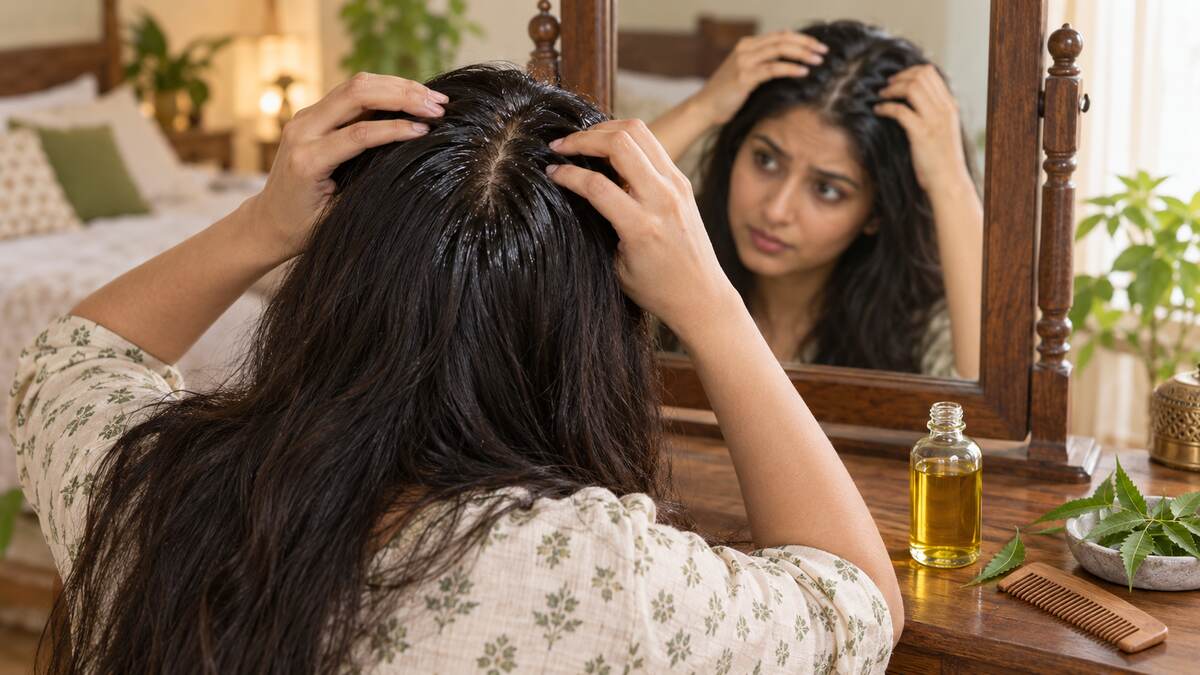
Many people believe that more oil means healthier hair. While Ayurvedic hair care values oiling as an important practice, applying too much oil or leaving it on the scalp for long periods may disturb scalp balance in some people.
An Ayurvedic approach considers Prakriti (body constitution), Dosha balance, scalp condition, diet and lifestyle habits before suggesting suitable care.
The right oiling routine can support scalp nourishment, but improper practices may contribute to oily scalp buildup and dandruff. In this blog, we explain:
- How excess oiling can affect scalp health and contribute to dandruff
- What Ayurveda says about oiling, Kapha balance and scalp care
- The correct way to oil your hair and support long-term scalp wellness
The Common Belief — More Oil, Healthier Scalp?
Hair oiling has been a part of traditional Indian hair care for generations. Ayurveda considers Sneha (oil therapy) valuable for nourishing the scalp, supporting hair strength and maintaining moisture balance.
However, Ayurveda also emphasises that every practice should match an individual’s body nature and current condition. The same oiling routine may not work equally for everyone.
A dry scalp may benefit from appropriate oil application, while an already oily scalp may become heavier with frequent oiling. The key is not using more oil but understanding what your scalp actually needs.
How Excessive Hair Oiling Can Actually Trigger Dandruff
While oil itself doesn't directly cause dandruff, excessive use can create conditions that worsen scalp imbalance.
The excessive hair oiling side effects may include a greasy scalp feeling, product buildup and difficulty maintaining scalp cleanliness. When oil stays on the scalp too long, it may mix with sweat, dust, and dead skin cells.
This can contribute to an environment where dandruff-related concerns become more noticeable.
What Happens When Oil Sits Too Long on the Scalp
Oil is meant to nourish the scalp, but timing and quantity matter. Leaving heavy oil layers for extended periods may:
- Trap dust and impurities on the scalp
- Make the scalp feel greasy and heavy
- Increase buildup around hair roots
- Affect normal scalp cleansing
From an Ayurvedic perspective, balance is important. Excessive application of Sneha (oil) without considering scalp type may disturb the natural state of the scalp.
Oil, Sweat, Dust and Fungal Growth — The Real Connection
A scalp naturally has microorganisms that are part of its ecosystem. However, excess oil, sweat and buildup may affect this balance.
This is why some people notice increased flakes after frequent oiling, especially when they already have an oily scalp. Understanding individual scalp needs is an important part of dandruff causes and treatment.
What Ayurveda Says About Oiling and Scalp Imbalance
Ayurveda does not view dandruff only as a surface-level scalp issue. It considers factors like Dosha imbalance, Agni, Ahara (diet), lifestyle and overall body constitution.
According to Ayurvedic principles, maintaining harmony between internal and external factors supports healthy hair and skin.
Understanding Kapha Dosha and Excess Oil (Sneha) on the Scalp
Kapha Dosha is associated with qualities such as heaviness, moisture and stability. When Kapha becomes aggravated, Ayurveda says excess oiliness, heaviness, and buildup may appear in different parts of the body, including the scalp.
The connection between Kapha dosha imbalance and scalp health is understood through signs such as:
- Excess scalp oiliness
- Heavy or sticky scalp feeling
- Increased buildup
- Hair that becomes greasy quickly
Ayurveda focuses on restoring balance rather than simply removing oil. The approach may include suitable hair care practices, dietary adjustments and lifestyle correction based on individual needs.
Signs Your Scalp Has a Kapha-Type Imbalance
A Kapha-dominant scalp may show certain patterns, such as:
- Oily roots within a short time after washing
- Sticky flakes that remain attached to the scalp
- A heavy scalp feeling
- Hair appearing flat due to excess oil
These signs do not mean everyone with dandruff has a Kapha imbalance. A proper Ayurvedic assessment considers Prakriti, Vikriti (current imbalance), lifestyle and scalp condition before suggesting a personalised approach.
How to Oil Your Hair the Right Way
Ayurveda does not reject oiling. We simply do not treat it as a “more is better” ritual. The correct way to oil hair depends on your scalp type, season, routine and current Dosha imbalance.
For a dandruff-prone scalp, we usually suggest light application, gentle massage and proper cleansing afterward. Heavy overnight oiling or repeated oil layering may not suit everyone, especially those with a greasy scalp or a Kapha-dominant tendency.
Ideal Oiling Frequency by Hair and Scalp Type
If you often wonder how often should you oil your hair, the answer is: not every scalp needs the same frequency.
A simple Ayurvedic guide may look like this:
- Dry scalp: 2–3 times a week in moderate quantity
- Normal scalp: 1–2 times a week
- Oily or dandruff-prone scalp: 1–2 times a week, with lighter oiling and shorter contact time
We usually advise applying only enough oil to lightly cover the scalp and roots. Leaving oil on for 30 minutes to 2 hours may suit many people better than keeping it on all day or overnight.
Best Ayurvedic Oils for Dandruff-Prone Scalp
The best hair oil for dandruff in Ayurveda is not one fixed product for everyone. The oil should match the scalp’s condition.
For dandruff-prone scalps, Ayurvedic oils may include herbs such as:
- Neem – traditionally used for scalp cleansing support
- Bhringraj – often used in Ayurvedic hair care
- Brahmi – valued for soothing support
- Karanja – used in selected scalp formulations
- Coconut oil base – may suit some people when used correctly
If the scalp is already greasy and heavy, even a good oil may backfire when overused. That is why we always connect scalp care with Prakriti, Vikriti and Dosha balance rather than random trial and error.
Ayurvedic Alternatives and Remedies for Dandruff
Ayurveda does not rely on oiling alone for scalp care. When flakes keep returning, we usually look beyond the surface. Ayurvedic remedies for dandruff often include scalp cleansing, diet correction, lifestyle regulation and, when needed, professional therapy.
A proper Ayurvedic plan for dandruff causes and treatment focuses on reducing buildup, improving scalp balance and correcting contributing factors from within.
Herbal Scalp Cleansing
If excess oiling is making the scalp heavy, herbal cleansing may help more than adding more oil. In Ayurveda, selected Ubtan or Churna-based washes are used to support scalp cleanliness without relying only on harsh cleansers.
Depending on scalp type, ingredients in traditional scalp care may include:
- Triphala
- Neem
- Amla
- Shikakai
- Reetha
These are chosen carefully. We do not advise self-mixing too many ingredients without knowing your scalp type, because even natural remedies should suit the individual.
Diet and Lifestyle Correction for Kapha-Dominant Scalp
An Ayurvedic scalp care routine is not complete without Ahara (diet) and Dinacharya (daily routine). If Kapha is aggravated, we often review habits that may be contributing to heaviness and buildup.
We may suggest:
- Reducing very oily, deep-fried and excessively heavy foods
- Avoiding irregular hair-wash habits
- Keeping the scalp clean after sweating
- Maintaining regular sleep
- Managing stress and digestive imbalance
Ayurveda sees the scalp as part of the whole system. So if Agni is weak and Kapha is aggravated, scalp issues may keep coming back despite repeated oiling or product changes.
When to Consider Panchakarma or Professional Ayurvedic Therapy
If dandruff is frequent, stubborn or linked with itching, greasy flakes or hair fall, home care may not be enough. This is when a proper consultation matters.
For Ayurveda for hair fall and dandruff, we may consider a personalised plan that includes internal medicines, external applications and, in selected cases, supportive therapies. If the imbalance is deeper, Panchakarma-based support may also be considered under expert guidance.
The Key is Right Balance, Not Excess
So, can too much oiling increase dandruff? In many cases, yes—it can, especially when the scalp is already oily, heavy or prone to buildup. Ayurveda teaches us that hair care is not about excess. It is about balance, timing and suitability.
We approach scalp concerns through Prakriti, Dosha balance, Ahara, Dinacharya and personalised care. If you are looking for Ayurvedic treatment in Kolkata for Hair & Skin, we can help you understand whether your dandruff is linked with scalp oiliness, Kapha imbalance or a broader lifestyle issue.
Book a consultation with us to explore a more suitable Ayurvedic approach for your scalp and hair health.
What People Also Ask
Does oiling your hair every day cause dandruff?
It may in some people, especially if the scalp is already oily or dandruff-prone. Daily oiling can increase buildup and make flakes more noticeable.
What is the right amount of oil to use on the scalp according to Ayurveda?
A light to moderate amount is usually enough. The scalp should be lightly coated, not drenched. The exact amount depends on scalp type and hair texture.
Which Ayurvedic oils help reduce dandruff without clogging the scalp?
Ayurvedic oils containing herbs like neem, bhringraj or brahmi may be used depending on the scalp type. The right oil should always be selected according to the individual’s condition.
Can dandruff be a sign of dosha imbalance rather than dryness?
Yes. In Ayurveda, dandruff may be linked with Dosha imbalance, including Kapha-related buildup or other scalp imbalances, not just dryness alone.
How long does it take for Ayurvedic dandruff treatment to show results?
It varies from person to person. The response depends on scalp condition, lifestyle habits, consistency and the type of Ayurvedic treatment advised.