
Key Takeaways
- Fistula and piles can feel similar, but different causes require different treatments.
- An Ayurvedic doctor uses your history, examination and tests when needed to distinguish them.
- Kshar Sutra may suit selected fistulas, while diet and local care support recovery.
A painful lump or itching near the anus may seem like piles. But when the same swelling returns or keeps releasing discharge, a fistula could be responsible. These anorectal disorders need different treatment.
Yes, a fistula can be mistaken for piles. Before discussing Ayurvedic treatment for fistula, we identify the cause through your history, examination and tests when needed. In Ayurveda, fistula is known as Bhagandara and piles as Arsha. Read this blog to clear all doubts!
Why Fistula and Piles Are So Often Confused?
Both affect the anal region, where discomfort can be difficult to describe. A visible lump alone cannot settle the fistula vs piles question, and both conditions can occur together.
What’re The Symptoms They Share?
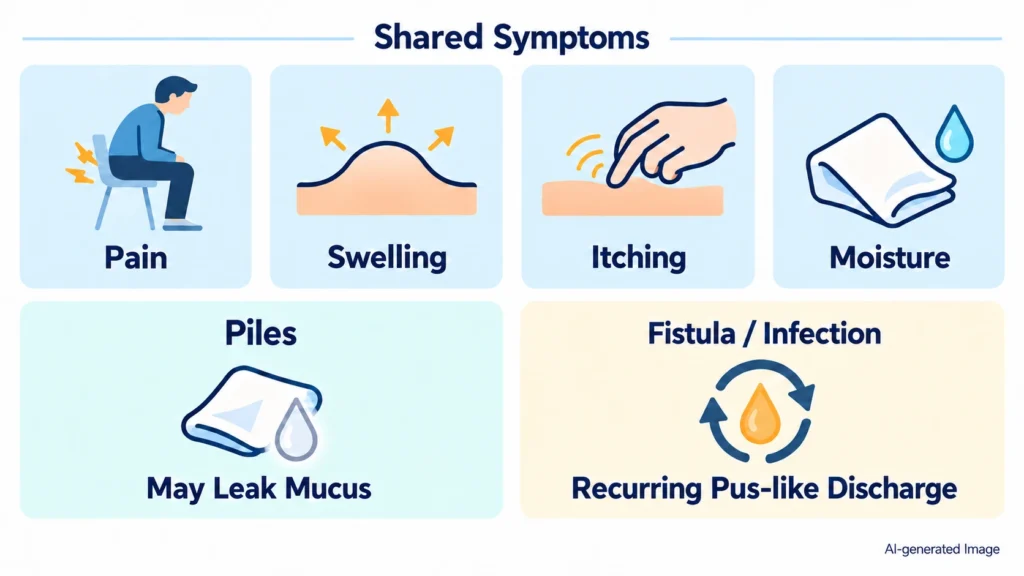
Pain, swelling, itching and moisture may occur with either condition. However, the discharge differs: piles may cause mucus leakage, while recurring pus-like discharge suggests a fistula or infection. Symptoms alone should not be used to diagnose either.
Why People Delay Seeing a Doctor?
Reluctance to talk about the problem, fear of a procedure, or temporary relief from creams may encourage people to wait. A swelling that settles can also seem reassuring. We encourage assessment when symptoms return, rather than repeatedly treating an assumed diagnosis.
What is an Anal Fistula?
An anal fistula is an abnormal tract connecting the anal canal to nearby skin. Known in Ayurveda as Bhagandara, it is a persistent passage, not an enlarged blood vessel.
How Does a Fistula Form?
A fistula commonly follows an infected anal gland and a perianal abscess, a collection of pus near the anus. After drainage, a tract may remain. Its outer opening can close temporarily while the underlying problem continues.
Key Signs: Recurring Boil, Pus Discharge, Pain While Sitting
Common anal fistula symptoms include:
- A boil or swelling that repeatedly returns.
- Discharge from a small opening near the anus.
- Throbbing discomfort, sometimes worse while sitting.
- Skin irritation around the opening.
Fever with worsening pain or swelling may indicate an abscess that needs prompt care.
What are Piles?
Piles are enlarged or displaced vascular cushions in or around the anal canal. These cushions normally help with anal closure. Ayurveda refers to piles as Arsha.
Internal vs External Piles
Internal piles develop inside the anal canal and may bleed or protrude during bowel movements. External piles occur beneath the skin around the anus. A blood clot within an external pile can cause a suddenly painful lump.
Key Signs: Bright Red Bleeding, Lump, Itching
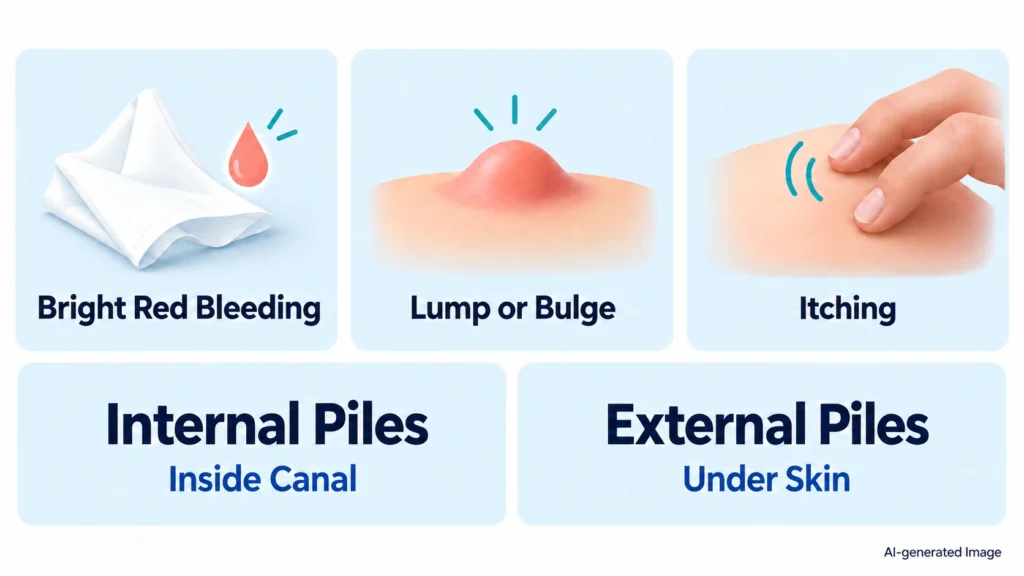
Typical piles symptoms include:
- Bright red bleeding after passing stool.
- A lump near the anus or tissue protruding during straining.
- Itching, irritation or difficulty cleaning the area.
Uncomplicated internal piles are often painless. Rectal bleeding still needs assessment because piles aren't the only cause.
Fistula vs Piles: A Side-by-Side Comparison
This fistula vs piles comparison highlights typical patterns, not a method for self-diagnosis.
| Feature | Anal Fistula | Piles |
| Cause | Usually a tract remaining after an anal abscess | Enlargement or displacement of vascular cushions |
| Bleeding | May accompany discharge | Often bright red after passing stool |
| Discharge | Recurrent pus-like drainage | Mucus leakage may occur; pus is not typical |
| Pain pattern | May worsen when drainage becomes blocked | Internal piles may be painless; clotted external piles can hurt |
| Swelling | Recurring boil or swelling near an opening | Lump at the anal edge or protruding tissue |
| Recurrence | Symptoms may return while the tract persists | Symptoms may flare with straining and constipation |
An examination is especially important when symptoms don't fit one clear pattern.
How an Ayurvedic Doctor Tells the Difference?
An Ayurvedic doctor in Kolkata assessing these concerns should establish the physical diagnosis before selecting treatment. Ayurvedic assessment adds context about constitution, digestion and daily habits.
Clinical History and Physical Examination
Traditional assessment includes Prashna (questioning), Darshana (inspection) and Sparshana (examination by touch). We discuss symptom duration, previous abscesses, bowel habits and earlier treatments.
A local examination looks for an external opening, discharge, tenderness or prolapsing tissue. A gentle rectal examination may be appropriate, depending on pain and clinical findings.
Proctoscopy, Probing and Imaging When Needed
Proctoscopy or anoscopy helps inspect the anal canal. MRI or ultrasound may be needed for recurrent or complex fistulas to map the tract and its relationship with the muscles controlling bowel movements.
Probing is not a routine self-care measure. If required, a trained specialist performs it carefully, sometimes during examination under anaesthesia, to avoid creating a false passage.
Ayurvedic Treatment for Fistula: What is Involved?
Treatment for Bhagandara depends on the tract’s course, infection and involvement of the anal sphincter muscles. Ayurvedic care may include a suitable procedure and supportive Ahara-Vihara, meaning diet and lifestyle guidance.
What is Kshar Sutra Treatment?
Kshar Sutra treatment uses a specially prepared medicated thread placed through the fistula tract, with appropriate anaesthesia. The thread acts gradually and is changed at scheduled appointments, commonly weekly. Ayurveda describes its actions through Chedana (controlled cutting) and Ropana (healing).
Although people search for non-surgical treatment for fistula, Kshar Sutra is a para-surgical procedure. It is not simply an external application or a course of medicine. Suitability, discomfort, healing time and risks—including recurrence or continence problems—require discussion with the treating specialist.
Diet, Sitz Baths and Lifestyle Support
Supportive care aims to keep bowel movements comfortable and the area clean:
- Include fibre-rich foods and adequate fluids.
- Avoid straining and prolonged toilet sitting.
- Use warm sitz baths if advised.
- Follow dressing instructions and attend reviews.
These measures support comfort and recovery; they do not close an established fistula tract on their own.
How Are Piles Managed Differently?
For Arsha, initial care often focuses on constipation, bowel habits and symptom relief. Persistent bleeding or prolapse may require a procedure. Options depend on the type and severity of piles; a fistula treatment plan should not automatically be applied to piles.
Why Choose Ayurvedic Treatment for Fistula at Our Clinic?
At Ayusya Ayurveda, we offer fistula assessment and Kshar Sutra therapy for suitable cases. Our approach considers the local condition alongside Prakriti (body constitution), Agni (digestive function) and bowel habits.
What Your First Consultation at Ayusya Ayurveda Looks Like
We discuss your symptoms, previous procedures and general health before explaining the next steps. Bring earlier reports and your medicine list. Mention diabetes, bowel disease or any difficulty controlling stool, as these can affect treatment decisions.
Personalised Care and Follow-Up
We plan care around the findings and review healing through follow-up. If Kshar Sutra is suitable, we explain thread changes, local care and expected discomfort. Complex disease or an unclear diagnosis may need further investigation or specialist referral.
When to See a Doctor Urgently?
Seek urgent care for severe anal pain with fever or rapidly increasing swelling. Heavy or continuous bleeding, particularly with dizziness or faintness, needs emergency assessment.
Arrange prompt evaluation for a non-healing wound, unexplained weight loss or a persistent change in bowel habits. Do not assume these symptoms are caused by piles.
Wrapping Up
Repeated discharge, bleeding or swelling deserves a clear diagnosis. At Ayusya Ayurveda, we help you understand the findings and available options. Book a consultation to discuss Ayurvedic treatment in Kolkata for Fistula and whether our approach suits your condition.
What People Also Ask About Fistula?
Can a fistula heal on its own without treatment?
Usually not. Temporary closure of the skin opening does not necessarily mean the underlying tract has healed.
Is Kshar Sutra treatment painful, and how many sittings are needed?
Discomfort can occur. The number of visits depends on tract length, complexity and healing response.
Can piles turn into a fistula?
No. They are separate conditions, although both may occur together.
What is the recovery time, and when can work resume?
Healing may take weeks or longer. Returning to work depends on discomfort, wound care and job demands.
Which foods should be avoided with fistula or piles?
Limit foods that worsen your constipation or diarrhoea. Include fibre and fluids; blanket food restrictions are usually unnecessary.