
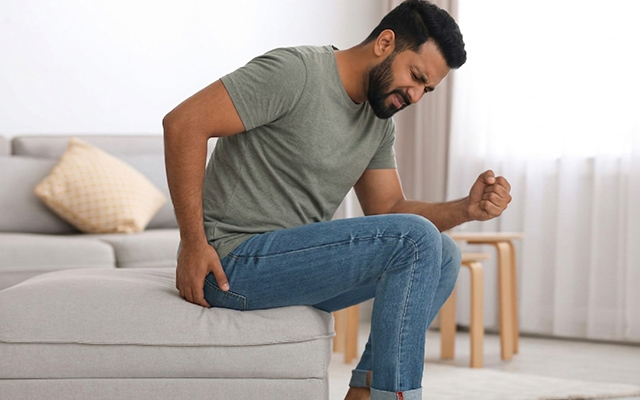
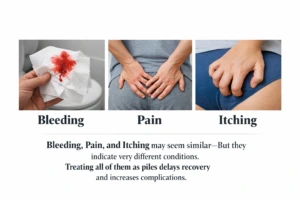
Bleeding, pain, or itching—most people immediately assume piles. But these symptoms don’t all mean the same thing, and treating them blindly often makes the condition worse.
When it comes to ayurvedic treatment for piles, the first step is not treatment—it’s correctly identifying the symptom pattern. Because what looks like piles could actually be fissures, irritation, or even infection.
At Ayusya Ayurveda, the focus is simple: don’t suppress symptoms—correct the root imbalance before it progresses.
Quick takeaway: what symptom you feel most often points to
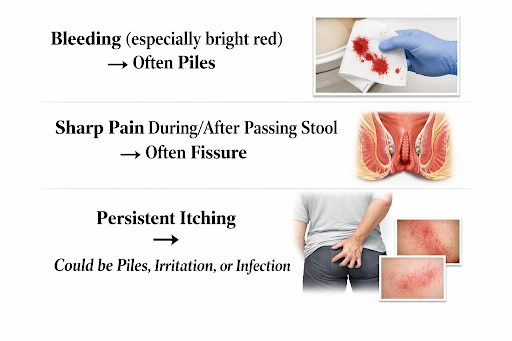
If you want quick clarity:
- Bleeding (especially bright red) → Often piles
- Sharp pain during/after passing stool → Often fissure
- Persistent itching → Could be piles, irritation, or infection
But symptoms overlap. That’s why guessing leads to wrong treatment—even when searching for piles treatment online.
First, rule out red flags (when you should see a doctor urgently)
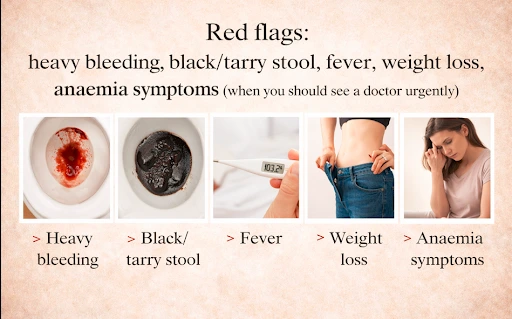
Before assuming it’s a minor issue, check for serious warning signs.
Red flags: heavy bleeding, black/tarry stool, fever, weight loss, anaemia symptoms
- Continuous or heavy bleeding
- Black or tarry stool
- Fever or discharge
- Sudden weight loss
- Weakness or signs of anaemia
These are not typical pile symptoms and need urgent evaluation.
Why “bright red” vs “dark/black” blood matters
- Bright red blood in stool without pain → Usually from lower rectum, often piles
- Dark or black stool → Indicates bleeding higher in the digestive tract
The colour of blood is often your first diagnostic clue.
Symptom 1: Bleeding (especially bright red) — what it commonly suggests
Bleeding is common—but its pattern matters more than its presence.
Most common benign causes: piles and fissures (and how they differ)
Understanding the piles vs fissure difference helps avoid confusion:
- Piles = swollen veins due to pressure
- Fissure = small tear caused by strain or dryness
Bleeding without much pain: more consistent with internal haemorrhoids (often)
If bleeding occurs without significant pain, it is usually due to internal piles.
This matches typical piles symptoms: bleeding, itching, and pain, with bleeding appearing early while discomfort remains mild.
Bleeding + sharp pain: more consistent with fissure (often)
If bleeding is accompanied by intense pain, especially after passing stool, it points toward a fissure. This reflects the pattern of pain after a bowel movement, in which a fissure can cause prolonged discomfort.
Other possible causes you shouldn’t ignore
Not all bleeding is piles:
- Polyps
- Infections
- Inflammatory bowel conditions
Ignoring these delays in proper treatment.
Symptom 2: Pain — what type of pain changes the diagnosis
Pain is often the most reliable differentiator.
Sharp pain during/after bowel movement (hours): classic fissure pattern
- Feels like a cut or tear
- Lasts for hours
- Repeats consistently
This is a classic fissure pattern.
Throbbing pain + lump/swelling: can be a thrombosed external haemorrhoid
If you notice:
- A painful swelling
- A lump near the anus
- Constant discomfort
It may be an external haemorrhoid with clot formation.
Pain with fever/discharge: consider infection/fistula and get evaluated
Pain combined with fever or discharge suggests infection or fistula, not piles.
Symptom 3: Itching — when it’s piles vs irritation vs infection
Itching is often misunderstood and misdiagnosed.
Moisture/leakage + itching: haemorrhoids can contribute
Piles can cause mild leakage, leading to irritation and itching. Pruritus ani (anal itching) can be caused by piles, fissures, or even fungal infection—this is why correct diagnosis matters.
Fungal/yeast irritation can mimic “piles itching” (and needs different treatment)
Not all itching near the anal area is piles. Fungal or yeast irritation can feel similar, but it needs a completely different approach.
Conditions like Pruritus ani (anal itching) are skin-related, so treatment focuses on calming irritation, keeping the area dry, and restoring skin health—not treating veins.
Skin irritation from over-wiping / harsh soaps: the underrated villain
Over-cleaning damages skin:
- Harsh soaps
- Excess wiping
- Rough tissue
This worsens itching instead of relieving it.
Piles vs fissure vs fistula: a simple comparison table
| Condition | What’s happening |
| Piles | Swollen veins due to pressure |
| Fissure | Tear in the anal lining |
| Fistula | Infected tract formation |
Symptom patterns (bleeding vs pain vs itching vs discharge)
| Symptom | Piles | Fissure | Fistula |
| Bleeding | Common | Possible | Rare |
| Pain | Mild/none | Severe | Moderate |
| Itching | Common | Sometimes | Possible |
| Discharge | No | No | Yes |
Understanding haemorrhoids vs anal fissure symptoms early prevents wrong treatment choices.
Why treatment differs (the “mechanics” behind the medicine)
Different causes require different solutions.
Hemorrhoids: reduce pressure + swelling + bleeding risk
Treatment focuses on:
- Reducing pressure in the veins
- Improving circulation
- Preventing strain
Fissure: heal the tear + relax spasm + prevent re-tearing
Effective fissure treatment aims at:
- Healing the tear
- Relaxing muscle tension
- Softening stool
Itching/infection: treat the skin cause (not the veins)
If the issue is skin-related, treating piles won’t help. Treat the skin cause, rather than the veins
Treatment aims:
- Control fungal/yeast growth
- Reduce itching and inflammation
- Repair the skin barrier
- Keep the area clean and dry
- Avoid irritants and friction
- Prevent recurrence
What you can do at home
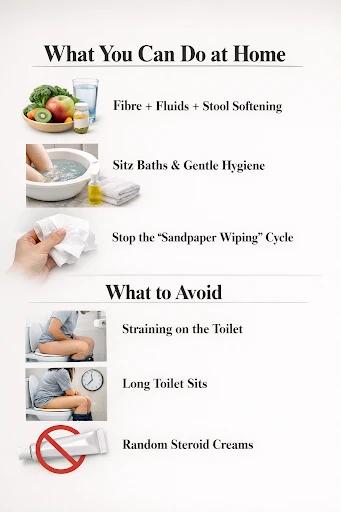
A few grounded, safe steps at home can steady the situation, reduce discomfort, and even prevent escalation.
Fibre + fluids + stool softening
Constipation is the root trigger in most cases. Smooth bowel movements start with what you eat and drink. Adequate fibre, steady hydration, and gentle stool softening reduce strain, ease discomfort, and support natural healing without aggravating the area.
In Ayurveda, weak digestion (Agni) leads to toxin buildup and hard stool, starting the entire problem.
- Increase fiber
- Drink enough water
- Keep bowel movements regular
Sitz baths, gentle hygiene, stop the “sandpaper wiping” cycle
- Warm sitz baths soothe tissues
- Gentle cleaning prevents irritation
- Avoid aggressive wiping
What to avoid (straining, long toilet sits, random steroid creams)
Avoid:
- Straining
- Long sitting
- Self-medication
These worsen the condition over time.
Doctor evaluation: what happens in a consultation
History + exam (and when tests are needed)
A proper consultation includes:
- Symptom pattern analysis
- Physical examination
- Minimal necessary tests
At Ayusya Ayurveda, this goes deeper—identifying dosha imbalance, digestive weakness, and toxin accumulation, which are often the real cause.
Treatment options (from least to most invasive)
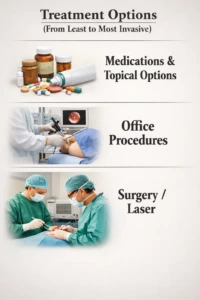
Medications & topical options (when appropriate)
Used in early stages for symptom relief.
Office procedures (when symptoms persist)
Recommended when symptoms don’t improve with basic care.
Surgery/laser: who actually needs it (and who doesn’t)
Not every case needs surgery.
- Laser piles treatment is useful in specific cases
- Laser fissure surgery is considered for chronic conditions
But many cases can be managed effectively without invasive procedures.
This is where choosing the right piles Ayurvedic treatment becomes important—because treating early often avoids surgery completely.
Which specialist to see (general surgeon vs gastro vs proctology)
Depends on the diagnosis and severity.
How people typically find care locally (clinics/hospitals/directories)
Most patients search online—but choosing root-cause treatment makes the difference.
Cost and variability factors (avoid giving one magic number; explain drivers)
Costs depend on:
- Severity
- Treatment approach
- Duration
There is no fixed number—only personalised care.
Prevention: reduce recurrence
Constipation loop breakers
- Regular bowel habits
- Hydration
- Fibre-rich diet
Diet + activity + toilet habits
- Eat on time
- Stay active
- Avoid delaying bowel movements
Consistency prevents recurrence.
People Also Ask
Can piles cause itching without pain?
Yes. Itching alone can be an early symptom of piles.
Is bright red blood always piles?
No. While common in piles, other causes must be ruled out.
Why does fissure pain last for hours?
Fissure pain lasts for hours because muscle spasm prevents immediate healing of the tear.
How long should I try home care before seeing a doctor?
If symptoms persist beyond 5–7 days, consult a specialist.
Final Verdict: match the treatment to the symptom pattern (not guesswork)
At Ayusya Ayurveda, treatment focuses on correcting the root imbalance, improving digestion, and preventing recurrence—not just temporary relief. If you are considering ayurvedic treatment for piles in Kolkata, the right approach starts with understanding your symptoms correctly.
Don’t wait for the condition to worsen. Treat the cause early, and avoid long-term complications.
Book your private session today.