
Many people today live in cycles of treatment. A symptom appears. Medicine is taken. Relief follows. Life continues. Until the same problem returns.
Sometimes it returns louder. Sometimes it changes shape. This pattern is now so common that recurrence is treated as normal.
Ayurveda does not see it that way.
In Ayurveda, when a symptom returns, it means the disease process was never interrupted. Relief was achieved, but healing was incomplete.
To understand why this happens, one must understand how Ayurveda defines disease, diagnosis, and treatment at the root level. That’s why consulting our ayurvedic doctor in Kolkata becomes crucial.
Ayusya Ayurveda does not aim to suppress symptoms. Rather, it asks why the body is producing them repeatedly. Until that question is answered, your healing remains incomplete.
Why Relief Is Often Mistaken for Recovery
Most treatment approaches focus on what is visible and measurable. Pain is reduced. Bleeding is stopped. Acidity is neutralised. Swelling subsides. These outcomes feel like success, but Ayurveda makes a clear distinction between symptom control and disease resolution.
Ayurveda calls symptom-based management Lakshana Chikitsa. True healing is Roga Moola Chikitsa, treating the origin of the disorder.
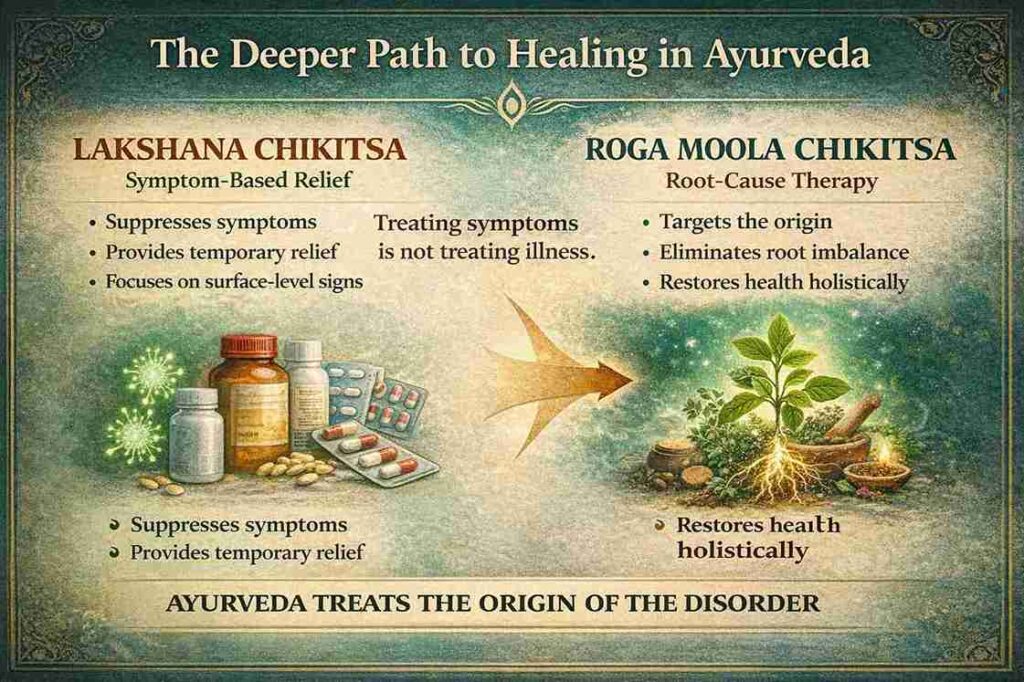
When treatment stops at surface relief, the internal imbalance continues silently. The body compensates briefly, then recreates the same problem.
This Ayurvedic take explains why symptoms keep returning consistently in chronic conditions.
What Ayurveda Means by “Root Cause”
In Ayurveda, disease begins long before symptoms appear. The starting point is Agni, the digestive and metabolic fire. When Agni weakens, food and experiences are not processed properly. This leads to the formation of Ama, a toxic residue that disrupts normal physiology.
The disease pathway follows a predictable pattern:
- Mandagni (weak digestion and metabolism)
- Formation of Ama (toxic, undigested residue)
- Srotorodha (blockage of channels)
- Dosha aggravation (Vata, Pitta, or Kapha)
- Dhatu impairment (tissue weakness)
- Visible symptoms
This understanding forms the basis of ayurvedic root cause healing, where treatment aims to interrupt the disease pathway itself rather than repeatedly managing its outcomes.
Unless this chain is broken, symptoms will return in the same or different form.
Why Common Symptoms Are Often Misdiagnosed
And Why They Keep Returning Despite Treatment
A major reason for recurrence is misdiagnosis at the root level. Many conditions are named by appearance, not by cause. Ayurveda treats symptoms as expressions of imbalance, not diseases themselves.
Knee Pain Is Not Just “Wear and Tear”
Knee pain is commonly attributed to ageing. Ayurveda differentiates between Sandhigata Vata, in which aggravated Vata causes dryness and degeneration, and Ama-janya Sandhi Shoola, in which toxins block nourishment and create inflammatory pain.
Ayurveda explains: treating both the same way leads to recurrence driven by dosha imbalance recurring health problems.
Acidity Is More Than Excess Acid
Acidity is often reduced to acid excess. Ayurveda diagnoses Amlapitta, caused by aggravated Pitta, along with weak digestion. Suppressing acid without strengthening Agni allows imbalance to persist.
Piles Are Not a Local Disorder
Piles are frequently treated as local swelling. Ayurveda recognises Arsha, arising from Mandagni and disturbed Apana Vata. Without correcting digestion and bowel regulation, symptoms return.
Skin and Sinus Conditions Are Systemic
Skin flare-ups are labelled as allergies, while Ayurveda identifies Rakta Dushti, often combined with Kapha involvement. Sinus congestion is treated as an infection, but Ayurveda diagnoses Kapha accumulation with Ama.
Table: Symptom Versus Root-Level Ayurvedic Diagnosis
| Common Symptom | Common Assumption | Ayurvedic Diagnosis |
| Knee pain | Wear and tear | Sandhigata Vata / Ama-janya Sandhi Shoola |
| Acidity | Excess acid | Amlapitta due to Pitta imbalance |
| Piles | Local swelling | Arsha with Mandagni and Apana Vata Dushti |
| Skin flare-ups | Allergy | Rakta Dushti / Kapha involvement |
| Sinus congestion | Infection | Kapha accumulation with Ama |
Why Symptoms Keep Returning With Conventional Approaches
When treatment targets only symptoms, the underlying imbalance persists silently.
Common patterns include:
- Pain relief without tissue nourishment
- Acid suppression without digestive correction
- Infection clearance without immune strengthening
- Hormonal regulation without metabolic balance
Ayurveda explains this as a failure to address the underlying causes rather than the symptoms. Without correcting Agni, clearing Ama, and balancing doshas, Samprapti, the disease pathway continues.
From an Ayurvedic perspective, ama toxins cause recurring illness —making relapse predictable rather than random.
How Ayurveda Diagnoses Differently
Ayurvedic diagnosis does not begin with the disease name. It begins with the person.
Assessment includes:
- Prakruti / Vikruti Dosha dominance
- Strength of Agnibala (digestive strength)
- Presence of Ama Lakshana
- Condition of Srotas Avrodha / Margavaraṇa (Channel)
- Health of Dhatu Paka / Dhatu Mala (Tissues)
At our Kolkata-based clinics, two people with the same complaint may receive different treatment plans. This precision defines holistic ayurvedic treatment for chronic diseases, where diagnosis itself guides healing.
Visit our clinic today, and rest assured that our experienced Ayurvedic doctor in Kolkata will assess the entire physiological picture rather than isolating a single symptom.
Conditions That Recur When Root Causes Are Missed
Ayusya Ayurveda treats a wide range of recurring conditions where root causes are often overlooked.
- Arsha (piles) recur when digestion and Apana Vata remain disturbed.
- Sandhigata Vata (knee pain) worsens when Asthi and Majja Dhatu are not nourished.
- Amlapitta (acidity) returns when Pitta is controlled, but Agni remains weak.
- Shwasa–Pratishyaya (sinus issues) repeat when Kapha and Ama are not cleared systemically.
- Twak and Rakta Vikara (skin disorders) flare when blood tissue imbalance persists.
These conditions reveal Ayurveda’s root-cause approach to healing chronic illnesses—a reliable path India trusts for lasting stability.
How Ayurveda Ensures Complete Treatment
Ayurveda aims for Apunarbhava, non-recurrence. This is achieved through a structured treatment framework.
Ayurvedic Treatment Layers
| Treatment Phase | Purpose |
| Shamana Chikitsa | Stabilise doshas and symptoms |
| Shodhana (Panchakarma) | Remove deep-seated Ama |
| Rasayana | Rebuild weakened tissues |
| Ahara–Vihara | Prevent future imbalance |
This structure indicates holistic ayurvedic treatment for chronic diseases, not isolated therapy.
Panchakarma and Breaking the Disease Cycle
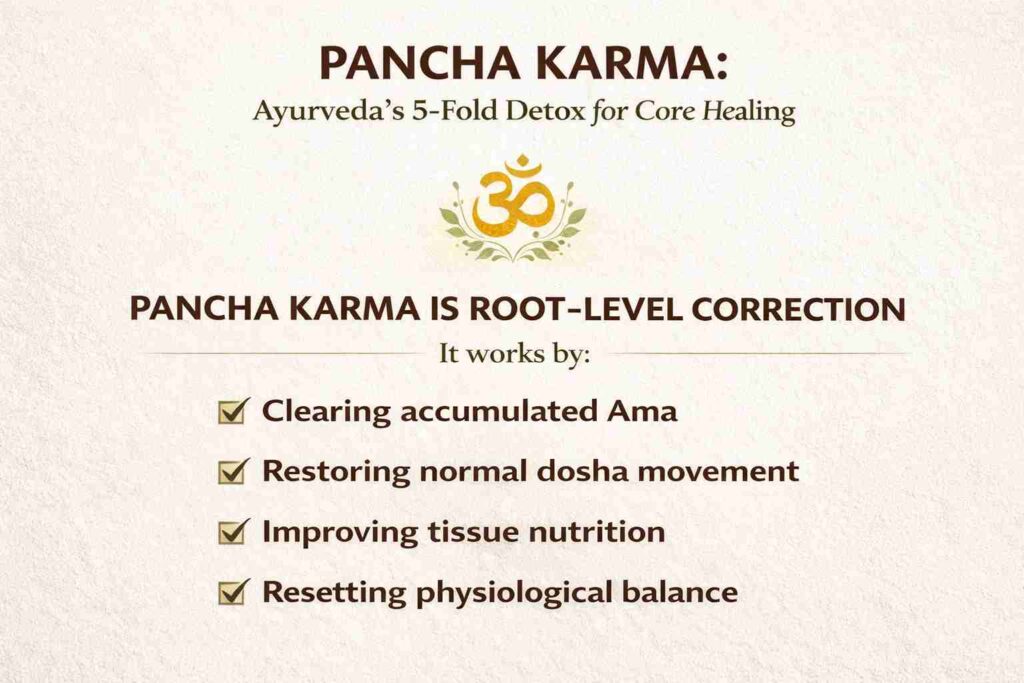
Therapies such as Abhyanga and Swedana improve circulation, open blocked channels, and prepare the body for deeper healing.
Ayurveda also offers chronic disease management without medicines during stabilised phases under supervision.
Why Modern Life Makes Recurrence More Likely
Urban lifestyles weaken Agni gradually.
Contributing factors include:
- Irregular meals
- Chronic stress
- Prolonged sitting
- Disrupted sleep
- Self-medication
Ayurveda addresses this gap by integrating holistic lifestyle changes alongside treatment for long-term health.
This is why people increasingly seek an ayurvedic healing approach in Kolkata and across India for sustainable care.
Ayurveda Is Not Alternative, It Is Foundational
Ayurveda does not oppose symptom-based care. It completes what symptom-based care leaves unfinished. It explains why relief fades and offers a pathway toward stability.
This is the principle behind natural ayurvedic remedies for recurring health issues when applied clinically.
Ayusya Ayurveda follows classical logic adapted to modern realities. Consulting our ayurvedic doctor in Kolkata means addressing recurrence, not accepting it.
Table: Symptom Care vs Root-Cause Care
| Aspect | Symptom-Focused Care | Ayurvedic Care |
| Focus | Relief | Resolution |
| Diagnosis | Condition-based | Dosha-Dhatu-Agni |
| Outcome | Temporary | Long-term balance |
| Recurrence | Common | Reduced |
At Ayusya Ayurveda, treatment is guided by classical understanding and modern relevance. The goal is not repeated management, but lasting correction.
When Symptoms Repeat, Depth Is Required
Choosing ayurvedic root cause healing is choosing completeness over cycles. And that is why Ayurveda continues to guide modern health seekers toward lasting stability.
Trust Ayusya Ayurveda for your well-being. Book a consultation today!
People Also Ask
Why do health problems return after stopping medicines?
Because medicines often control symptoms, not digestion, dosha balance, or toxin build-up that caused the problem initially.
Why do issues worsen during busy work phases in the city?
Irregular meals, stress, late nights, and long hours of sitting weaken digestion and trigger recurrence.
Can different problems come from the same internal issue?
Yes. Weak digestion and toxin buildup can show up as joint pain, skin issues, acidity, or fatigue.
Is recurrence a sign that the condition is serious?
It signals incomplete treatment, not severity. Ignoring it early often leads to chronic stages.
When should someone stop self-managing and seek help?
When symptoms repeat despite lifestyle tweaks or temporary relief, deeper evaluation becomes necessary.